

The Truth About F.O.C. (Forward of Center) and Arrow Stability
By Eric Newman | PNL Testers
Introduction
The concept of Forward of Center (F.O.C.) is widely discussed, yet frequently misunderstood. While many believe that a high F.O.C. is essential for arrow stability, this view often oversimplifies a more complex aerodynamic relationship. In reality, static margin, not F.O.C. alone, determines stability. This paper aims to clarify the role of F.O.C., address common misconceptions, and explain why even low or negative F.O.C. arrows can fly with stability under the right aerodynamic conditions.
What F.O.C. Really Is
F.O.C. refers to the percentage of an arrow’s total length by which the center of gravity (CG) is forward of the midpoint. It’s commonly calculated using:
F.O.C. (%) = [(A – (L ÷ 2)) ÷ L] × 100
Where:
- L = total arrow length (nock groove to shaft end)
- A = distance from nock groove to balance point
F.O.C. is easy to measure, but it's not a direct measure of stability. That role belongs to another, often overlooked metric: the static margin.
Static Margin: The Real Key to Stability
The static margin is the distance between the center of gravity (CG) and the center of pressure (CP). Stability increases as this distance grows. While F.O.C. affects CG, it says nothing about CP, which is largely governed by vane size, placement, and aerodynamic shape.
You can have a high F.O.C. and still experience instability if the CP is also moved forward (e.g., due to large fixed-blade broadheads). Conversely, you can achieve excellent stability, even with low or negative F.O.C., if the static margin remains large.
Misconceptions About F.O.C.
- “You need high F.O.C. for stable flight.”, Not true. High F.O.C. often coincides with stability but isn’t the cause.
2. “My arrows fly great, so F.O.C. isn’t important.”, That’s because your static margin is adequate, even if unintentionally.
3. “Low F.O.C. = poor flight.”, Many target archers shoot low F.O.C. setups with excellent accuracy, thanks to optimized spine and vane configuration.
Lift, Drag, and Arrow Stabilization
Another frequent myth is that fletching stabilizes arrows by adding drag. In reality, lift is the primary stabilizing force. As the arrow yaws off-axis, fletching generates lift at the rear, creating a corrective torque that restores alignment with the airflow.
Experimental Evidence
- Arrows with negative F.O.C. can stabilize if vanes are adjusted to increase static margin.
- Broadhead-induced instability often correlates with forward CP movement, not insufficient F.O.C.
- Grouping and stabilization improve when adjustments increase the static margin, regardless of the F.O.C. percentage.
Practical Tuning Guidance
- Assess Static Margin.
2. Shift CP Rearward using longer or more offset vanes.
3. Stabilize Broadheads by managing CG and CP shifts.
4. Test Low-F.O.C. Arrows, they often perform better than expected when properly tuned.
Final Thoughts
F.O.C. is a valuable tool, but not a standalone indicator of performance. Understanding static margin gives you true control over arrow behavior. Whether you're shooting high, low, or even negative F.O.C., it’s the aerodynamic balance between CG and CP that determines how well your arrow flies.
Visualizing Static Margin vs. F.O.C.
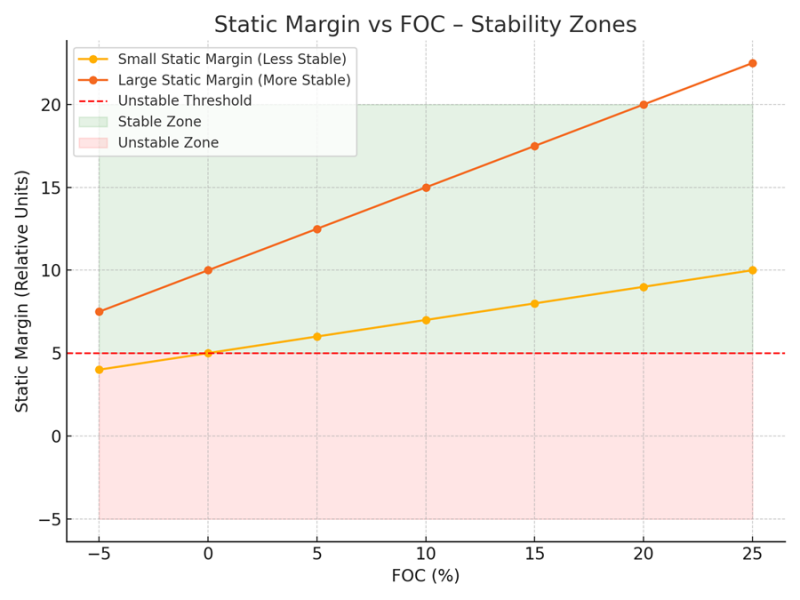
The chart shows how static margin increases with F.O.C. when the center of pressure (CP) is fixed. The 'Large Static Margin' line represents arrows with CP positioned far behind the CG (usually due to large rear vanes), resulting in more stability across all F.O.C. levels. The 'Small Static Margin' line represents arrows where CP is closer to CG, creating a narrow margin and less stability unless F.O.C. is significantly increased.
The key takeaway: a large static margin can keep an arrow stable even with low or negative F.O.C., while a small static margin makes stability more sensitive to F.O.C. changes. It's the CG–CP relationship, not just the F.O.C. number, that governs arrow flight behavior.
References
- Darrel Ray Barnette, How Do Arrows Fly? (YouTube)
- NASA Glenn Research Center, Center of Gravity
- NASA Glenn Research Center, Center of Pressure
- NASA Glenn Research Center, What is Lift?
- SKYbrary Aviation Safety, Drag
- SpaceModeling.org, Calculating the Center of Pressure
- Darrel Ray Barnette, Visuals on Arrow Stability
- Bow International, Dynamic Behavior of Arrows
- Bow International, Minimizing Drag & Maximizing Lift
- Glenn Research Center, Aerodynamic Forces