

Target reaction timing and arrow impact: A sound-based analysis
Explore the critical role of sound in target reaction before arrow impact. This analysis challenges conventional understanding, offering experienced archers and bowhunters a new perspective on shot dynamics and animal movement.
Target Reaction Timing and Arrow Impact: A Sound-Based Analysis Using Controlled Drop Testing
By Eric Newman
Introduction
In archery, target movement prior to arrow impact is often attributed to distance or arrow speed. However, this perspective does not account for the delay between the moment of the shot and the arrival of sound at the target. Because sound travels at a finite speed, a target cannot react until sound arrives. The remaining time between reaction and impact determines how much movement can occur. This study quantifies target movement as a function of reaction timing after sound arrival.
Core Concept: Sound-Based Reaction Timing
Sound travel time was calculated based on distance and standard speed of sound and was not directly measured. Variations due to environmental conditions are expected to be small relative to overall reaction timing and do not affect the conclusions of this study.
At 30 yards, sound reaches the target in approximately 0.080 seconds. Reaction time must therefore be defined relative to sound arrival:
Reaction time after sound = t_drop − t_sound
Converted test conditions:
Release Time (s) Reaction After Sound (s)
0.3 0.22
0.25 0.17
0.2 0.120
0.15 0.07
Relationship Between Reaction, Arrow Position, and Impact
Once reaction timing is defined relative to sound arrival, the full interaction can be described using three linked variables:
- Reaction time after sound
• Arrow position at the moment of reaction
• Remaining time before impact
These variables are directly related. As reaction occurs sooner after sound arrival:
- The arrow is farther from the target
• The remaining time before impact increases
• The resulting target displacement increases
This relationship forms the basis for interpreting the measured impact deviation observed in this study.
Arrow Position at Reaction
Using measured velocity data, arrow position at reaction timing was determined. For example, at 0.120 seconds after sound, the arrow has traveled approximately 11.5 yards and is 18.5 yards from the target. At 0.220 seconds, the arrow is approximately 9 yards from the target.
Time Remaining Before Impact
For a 379 grain arrow, the total time of flight is approximately 0.319 seconds. After sound arrival, approximately 0.239 seconds remain. If reaction occurs at 0.220 seconds, this represents the maximum available time for target movement prior to impact. After sound arrival, only 0.019 seconds remain before impact.
Experimental Validation
Testing was conducted using HELIOS, a PLC-controlled automated shooting system designed to eliminate human variation. A controlled drop system initiated target motion at predefined times. Impact deviation was measured relative to a stationary baseline.
Results
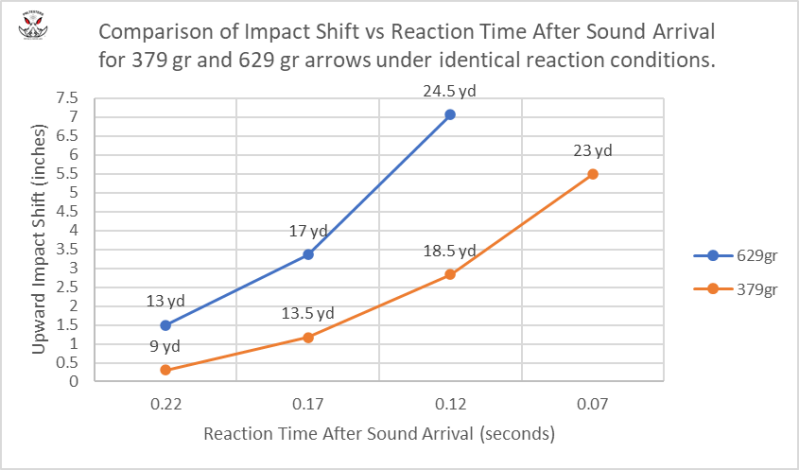
Impact deviation increased as reaction occurred sooner relative to sound arrival. At early reaction timings, the arrow was farther from the target and more time remained before impact, allowing greater displacement under gravity. At later reaction timings, although the arrow was still several yards from the target, the remaining time before impact was extremely limited, resulting in minimal movement. At 0.220 seconds after sound, measured displacement was approximately 0.3125 inches, consistent with the limited remaining time (~0.019 seconds) before impact.
Figure 1. Impact Shift vs Reaction Time After Sound Arrival for 379 gr arrow.
Data labels indicate distance remaining to the target at the moment of reaction (yards). Distance was calculated using measured velocity data (Labradar) and corresponding time values.
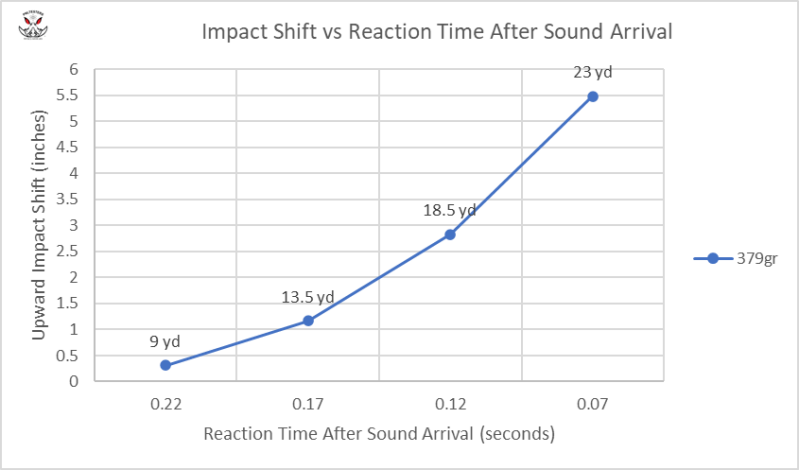
Figure 2. Impact Shift vs Reaction Time After Sound Arrival for 629 gr arrow.
Data labels indicate distance remaining to the target at the moment of reaction (yards). Distance was calculated using measured velocity data (Labradar) and corresponding time values.
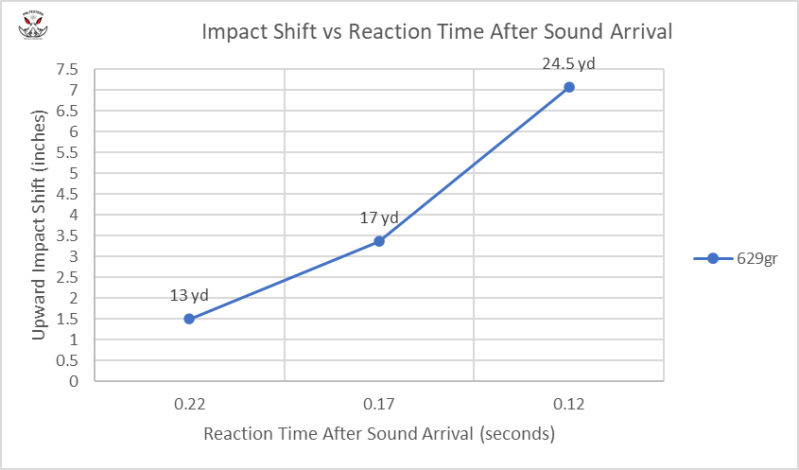
Figure 3. Comparison of Impact Shift vs Reaction Time After Sound Arrival for 379 gr and 629 gr arrows. Data labels indicate distance remaining to the target at the moment of reaction (yards) for both arrow configurations. Distance was calculated using measured velocity data (Labradar) and corresponding time values.
Conclusion
Target movement prior to arrow impact is governed by time remaining after reaction, not distance alone. Once sound reaches the target, the available time before impact determines the magnitude of movement. Even when the arrow is several yards away, limited remaining time can restrict movement to fractions of an inch. This sound-based framework provides a physically accurate method for interpreting target reaction and arrow impact.